

Home page " Digital resources " Licensed databases " The History of Afghanistan Online
The History of Afghanistan Online
The most important history of Afghanistan ever written: Siraǧ al-tawārīḫ or The History of Afghanistan. It was commissioned by the Afghan prince and later Amir Habib Allah Khan as an official national history.
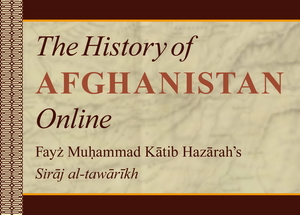
The most important history of Afghanistan ever written (originally in Persian): Siraǧ al-tawārīḫ or The History of Afghanistan. It was commissioned by the Afghan prince and later Amir Habib Allah Khan (r. 1901-1919) as an official national history. The author, Fayz Muhammad Khan, better known as "Katib" (the scribe), was a scribe at the royal court.
For more than twenty years he had unrestricted access to government archives and oral sources, providing a unique picture of the country from its founding in 1747 to the end of the nineteenth century. The roots of much of contemporary Afghan society - tribal and state relations, the rule of law, gender issues and economics - are elegantly and meticulously described in this massive work.
- The Sadūzāʾī Era, 1747-1843 (Volume 1)
- The Muḥammadzāʾi Era, 1843-1880 (Volume 2)
- The Reign of Amīr ʿAbd al-Raḥmān Kāhn, 1880-1889 (Volume 3, Part 1)
- The Reign of Amīr ʿAbd al-Raḥmān Kāhn, 1889-1893 (Volume 3, Part 2)
- The Reign of Amīr ʿAbd al-Raḥmān Kāhn, 1893-1896 (Volume 3, Part 3)
- Conclusion (Tatimmah) September 1896-May 1897 (Volume 3, Part 4)
- June 1897-July 1898 (Volume 4, Part 1)
- July 1898-October 1901 (Volume 4, Part 2)
- October 1901-July 1905 (Volume 4, Part 3)
- August 1905-February 1919 (Volume 4, Part 4)
- Indices to Volumes 1, 2, and 3 (Parts 1-3)
- Indices to Volumes 3 (Conclusion) and 4 (Parts 1-4)
Members of a university can usually use an existing institutional registration. This procedure enables German universities, research institutions and academic libraries to use a simple Access without special login. If your computer is not located in the campus area of your home institution, you should enquire locally about other access options (e.g. local login via VPN).
In order for access to be activated, institutions must have the National licence into their portfolio. Test here whether this is already the case for you. If you only reach a login page, you should ask your library to activate the collection.
Interested parties without access via a home institution can register for private access, provided they have their permanent residence in Germany. After successful Registration you will promptly receive your personal access data by post.