


Survey: Which transcription for Ottoman manuscripts?
Introduction
The FID has asked the members of the Society for Turkology, Ottoman Studies and Turkish Research (GTOT) on the transliteration or transcription of Ottoman in manuscripts and archive materials.
In the period from October 2020 to January 2021, 33 complete responses were received. In view of the very specific topic and the very discursive nature of the survey, this is a good response rate.
Below you will find an analysis of the survey results. We would like to thank all participants for the arguments presented.
Summary
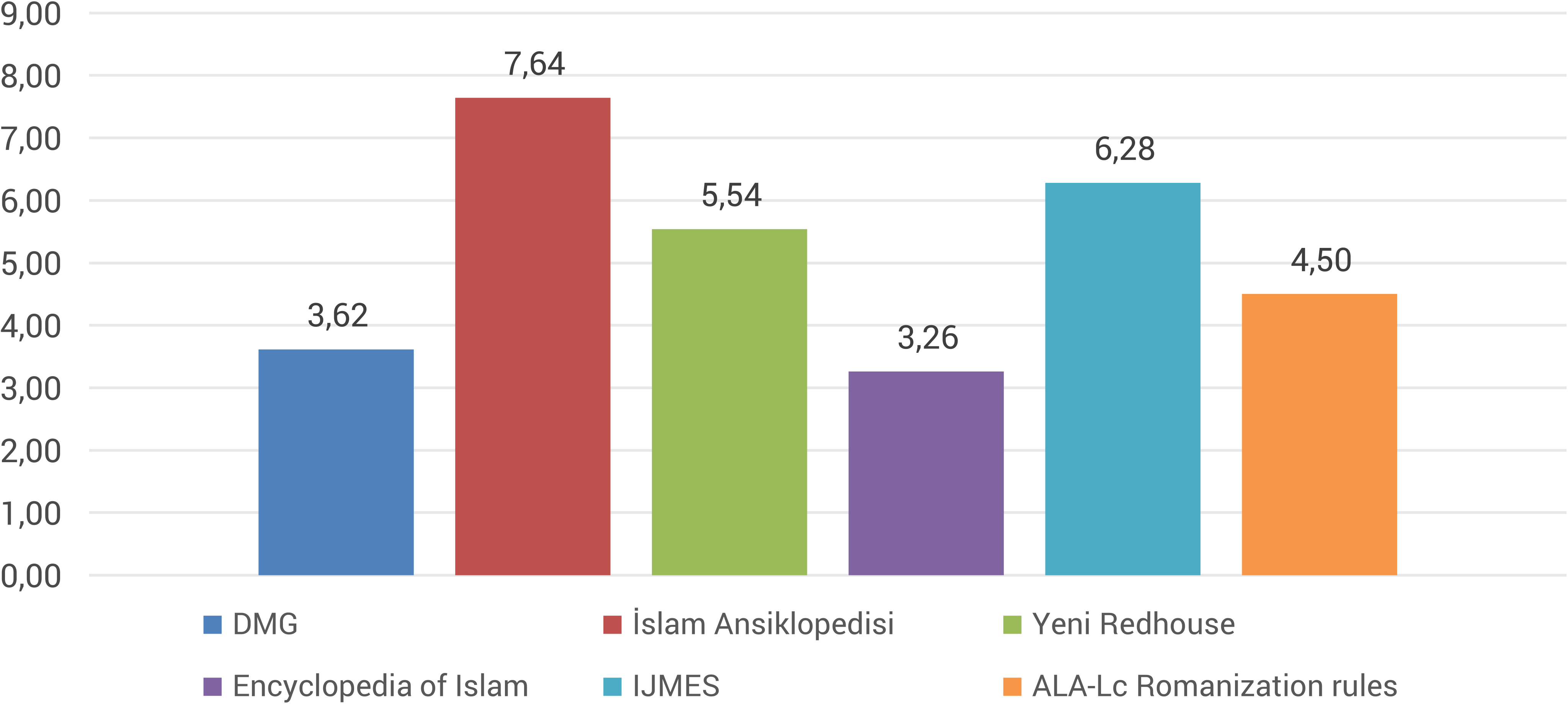
A clear trend can be identified from the survey and other expert opinions obtained. The majority of respondents recommended that libraries should use the transcription of the İslam Ansiklopedisi when cataloguing Ottoman manuscripts.
It combines Arabic and Turkological requirements for accuracy and is internationally recognised, so that an exchange with Turkish Ottoman Studies in particular is not hindered.
In the case of unclear vocalisation, the orthographic rules of Yeni Redhouse can be used. This applies, for example, to the handling of epenthetic vowels such as bahis/bahs or the handling of Arabic articles.
In the case of İzafet, it is suggested that it should not be adapted phonetically, but generally rendered with -i or -yi.
It would still have to be decided whether vowel lengthening should be marked with a circumflex or macron: â, î, û or ā, ī, ū. In the German library system, the spelling with ā, ī, ū dominates and it would be advisable to retain this. Since the search in library catalogues is usually carried out using the basic letters, retrieval is ensured in both cases.
Results of the survey
Arguments DMG transcription
Pro
- Suitable for titles with a strong Arabic component, as similarities can be visualised (uniform transliteration)
- Accuracy, clear assignment of the transcription characters
Contra
- No internationality; developed for German Arabists (requires corresponding specialisation)
- despite the attempt to create exactness, ultimately a special national path (not suitable in times of international exchange)
- Isolation (unusable for communication with Turkish researchers)
- No consideration of Turkish/Persian vocalisation; Arabicisation of vocalisation - unsuitable for Turkish
- Spelling of many consonants differs greatly from today's Turkish
- Too complex, not suitable for cataloguing
Arguments İslam Ansiklopedisi
Pro
- Distribution, internationality
- Consideration of the Arabic alphabet as well as meaningful vocalisation
- Accuracy (combines the requirements of Arabic and Turkish studies)
- suitable for Ottoman because of its proximity to Turkish
- Originally developed for the transcription of Arabic and Persian terms
- Currently the most usable system
Contra
- Weaknesses in the vocalisation of Turkish, e.g. in the spelling of ezafet, the long vowels within a word - standardisation desired here
- Different handling for Arabic articles
- Transliterations of Arabic and Persian terms deviate too much from the usage of Arabists and Iranians - too much Turkification of these terms
- Diacritics could be a hindrance when exchanging data.
Arguments Yeni Redhouse
Pro
- Suitable for vocalisation in unclear cases
- Easily accessible, suitable for catalogues
- Proximity to Turkish
Contra
- Not suitable for Arabic and Persian terms, as only transcription and no transliteration
- Vocalisation inconsistent, based on processing time, no clear reference work
- Too strongly orientated towards modern Turkish, no consideration of Arabic issues in older titles
Arguments Encyclopedia of Islam
Pro
- Internationally widespread and well-known
- All Arabic letters are reproduced with exact transcription characters
Contra
- Due to the English pronunciation transliteration of some Arabic letters by two Latin letters (with underscore) > prevents reversibility or unambiguity in the search (search engines do not distinguish between sh and sh)
- Arabic transcription of some consonants differs greatly from Ottoman pronunciation
- Significant deviation from Turkish (high familiarisation effort)
- No regulation for "ğ" and nasal "ñ"
- Already differences in the application between EI2 and EI3
Arguments IJMES
Pro
- Internationality, wide distribution
Contra
- Too much reliance on English pronunciation
- Lack of exactness; inconsistencies with several Arabic letters (kef, ghain)
- Transliteration table only, not a set of rules, but recommendations from a journal
- Thus orientation to İslam Ansiklopedisi possible, but not suitable for cataloguing
- For cataloguing, İslam Ansiklopedisi would be preferable
Arguments ALA-Lc Romanisation
Pro
- Proximity to Turkish
Contra
- Too much reliance on English pronunciation
- Inaccuracy, inconsistency
- Difficult to use correctly
- Too strong a tendency to Turkify Ottoman terms (e.g. hardening of pronunciation)
- No reversibility
Further suggestions
Korkut Buğday's textbook for the Ottoman language
Buğday, Korkut M.:
Ottoman : introduction to the basics of the literary language / Korkut Bugday. - Wiesbaden : Harrassowitz, 1999 - XXI, 311 p. ; 24 cm
ISBN 3-447-04154-4
Pro:
Close to Turkish but no consonant hardening and "itmek" is transcribed as e with a dot over it: ėtmek
Pear tree
Eleazar Birnbaum, 'The Transliteration of Ottoman Turkish for Library and General Purposes', Journal of the American Oriental Society, 87.2 (1967), 122-56 <https://doi.org/10.2307/597394>.
Pro:
unambiguous transliteration close to Turkish orthography, all ambiguities resolved
ISO 233-2 (1993)
Transliteration of Arabic letters into Latin letters; Part 2: Arabic language; Simplified transliteration
Transliteration Bacqué-Grammont as in Stelae
Pro:
Philologically even more accurate than Birnbaum
Contra:
laborious to create through superscripts and not very stable when converting files
General information from survey participants
İzafet
"In the case of İzafet, it should be considered whether it would be better to avoid the bad habit of adapting it phonetically and instead always write -i (or -yi) (i.e. better mevzu'-i bahs than mevzu-u bahis). The handling of epenthetic vowels (bahs/bahis, şehir/şehr) must also be regulated."
Without an excess of diacritical marks
"Personally, I don't usually use transliteration, but a transcription that is based on the practice in the new İslâm Ansiklopedisi. When reading historical articles in particular, I have the impression that many colleagues proceed in a similar way, but that the transcription technique often lacks a certain consistency. (I don't exclude myself from this.)
In principle, I particularly welcome readability - and writing systems that do without an excess of diacritical marks and can therefore be displayed digitally in many formats, are searchable and can also be entered by students and non-specialists without major technical problems.
One case here is vowel elongation, which in almost all the transcription systems mentioned is represented by the horizontal line above the vowel, which is more laborious and, in my opinion, has no clear advantage over the â, î, û variant. The circumflex has the advantage that it is easy to enter on any keyboard and is similar to the spelling in Turkish.
For centralised databases in particular, clear transliteration is of course essential. However, searchability from all possible end devices must also be guaranteed in the 21st century."
Transcription according to the pronunciation
DMG for Arabic
İslâm Ansiklopedisi for Ottoman
Bozorg Alavi for Persian
"Basically transcription according to pronunciation, possibly with some additional diacritical marks from DMG transliteration to make the Arabic spelling of some letters comprehensible and to avoid confusion in meaning."