


Turkologischer Anzeiger
The most important systematic bibliography for Turkology and Ottoman Studies is the Turkologische Anzeiger/Turkology Annual (TA). Experts from all over the world are involved in its composition. The volumes published by the Institute of Oriental Studies at the University of Vienna were previously only available in print.
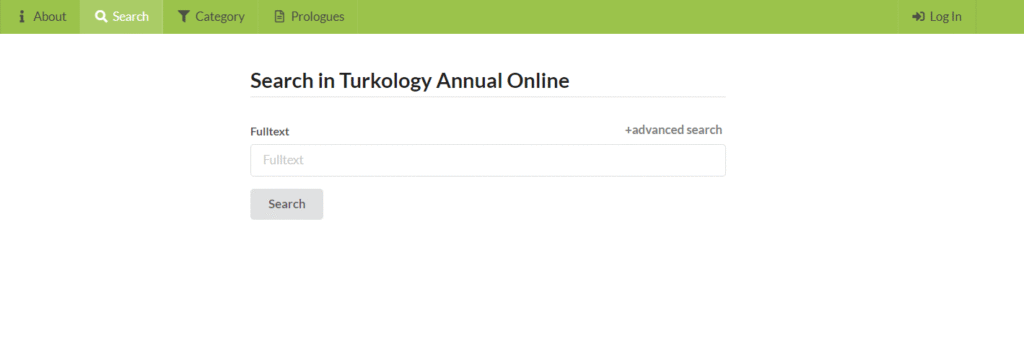
In consultation with Heidelberg University Library and the Gesellschaft für Turkologie, Osmanistik und Türkeikunde (GTOT e. V.), the "Turkologischer Anzeiger Online" database originally developed by Heidelberg University Library will be continued and expanded by the Middle East Specialised Information Service at the University and State Library of Saxony-Anhalt from 2023.
The Turkologische Anzeiger (TA), founded by Andreas Tietze (†) and György Hazai, is an important systematic bibliography for Turkology and Ottoman Studies. The volumes published by the Institute of Oriental Studies at the University of Vienna were previously only available in print. As part of a project at the Cluster of Excellence "Asia and Europe in a Global Context" of Heidelberg University, the first 26 volumes were digitised and all entries were made available in an online database with search options.
In 2023, a new database with corresponding functionalities was set up at the FID analogue to the original project and the previous content was made accessible and searchable. The entries in volumes 27-30 were added to the existing category scheme. With regard to a future funding phase, the FID Middle East intends to continue the TA at the request of the GTOT using modern reference systems, but the aim is above all to develop it further in library terms.
As the TA volumes contained entries in many different languages, including transcriptions from Arabic and languages with the Cyrillic alphabet, full-text recognition (OCR) posed major challenges for the original project. Individual entries sometimes consist of sections in different languages. However, the results proved to be very satisfactory in most cases (also as a result of subsequent fine-tuning). The syntax analysis (parsing) of the TA entries posed a greater problem, as the different entry types and their data structures are often only implicitly labelled and some of them change from volume to volume.